By the Zespo team · Updated 12 November 2026
Tongkat Ali is one of the most searched botanical names on Indian supplement shelves, yet few people know what the plant actually is, where it grows or what the numbers printed next to it mean. This guide covers the plant, the extract forms you will see on a label, and the details worth checking before you buy any Tongkat Ali product.
What is Tongkat Ali?
Tongkat Ali is the common Malay name for Eurycoma longifolia, a slender evergreen tree in the Simaroubaceae family. It grows wild in the lowland rainforests of Malaysia, Indonesia, Thailand, Vietnam and Laos, and can reach 10 to 15 metres in height. The name translates loosely as "Ali's walking stick", a nod to its long, twisted root. In Indonesia the plant is called Pasak Bumi, and in English-language markets it is often sold as Longjack.
The part used is the root. In Southeast Asia the dried root has long been cut into chips and boiled into a bitter tea, or blended into packaged coffee sold in local markets. The bitterness comes from a group of plant compounds called quassinoids, of which eurycomanone is the best known. The root also contains alkaloids, glycopeptides and polysaccharides.
Because a wild tree takes several years to develop a usable root, Malaysia regulates the harvest and has published a national standard for Tongkat Ali water extract (MS 2409). Today much of the material on the international market comes from cultivated plantations as well as wild collection.
How the root becomes an extract
Raw root is washed, sliced, dried and milled. Manufacturers then steep the milled root in hot water (sometimes water mixed with ethanol), filter the liquid, concentrate it and dry it into a fine powder by spray-drying or freeze-drying. Hot-water extraction mirrors the traditional tea method and is the most common approach for commercial Tongkat Ali.
Forms you will see on labels
- Root powder – dried, ground root with no concentration step. The mg on the label is simply the weight of root.
- Ratio extracts (50:1, 100:1, 200:1) – the ratio describes how much raw root went into the finished extract. "100:1" means roughly 100 kg of dried root was processed to make 1 kg of extract. A ratio tells you about the starting material, not the exact amount of any single compound.
- Standardised extracts – these state a percentage of a marker compound, for example "standardised to 1% eurycomanone" or a stated percentage of glycopeptides. Standardisation is about batch-to-batch consistency.
- Combination formulas – Tongkat Ali paired with other botanicals or amino acids. Here the label should list each ingredient with its own mg amount, not one "proprietary blend" figure.
When you compare two products, compare like with like: 400 mg of a 100:1 extract and 400 mg of plain root powder are very different materials, even though the milligram number is the same.
Ingredients often paired with Tongkat Ali
- Horny Goat Weed – the common name for Epimedium, a leafy plant native to China and East Asia; extracts are often standardised to a compound called icariin.
- Korean Ginseng – the root of Panax ginseng, usually described on labels by its ginsenoside content.
- Beet Root – powder or extract of Beta vulgaris, the same vegetable found in Indian kitchens.
- L-Arginine – an amino acid present in everyday foods such as peanuts, almonds, dairy and pulses.
What to check on the pack
- Botanical name and plant part – look for Eurycoma longifolia, root.
- Amount per serving – and how many capsules make one serving. 1,300 mg across two capsules is 650 mg per capsule.
- Extract type – ratio, standardised percentage or plain powder.
- Full ingredient breakdown – every ingredient with its own mg figure.
- Batch number, manufacturing date and expiry date.
- FSSAI licence number – required on every nutraceutical sold in India; you can verify it on the FSSAI FoSCoS portal.
- GMP certification of the manufacturing facility.
- Green or brown dot – the vegetarian or non-vegetarian mark that tells you about the capsule shell and ingredients.
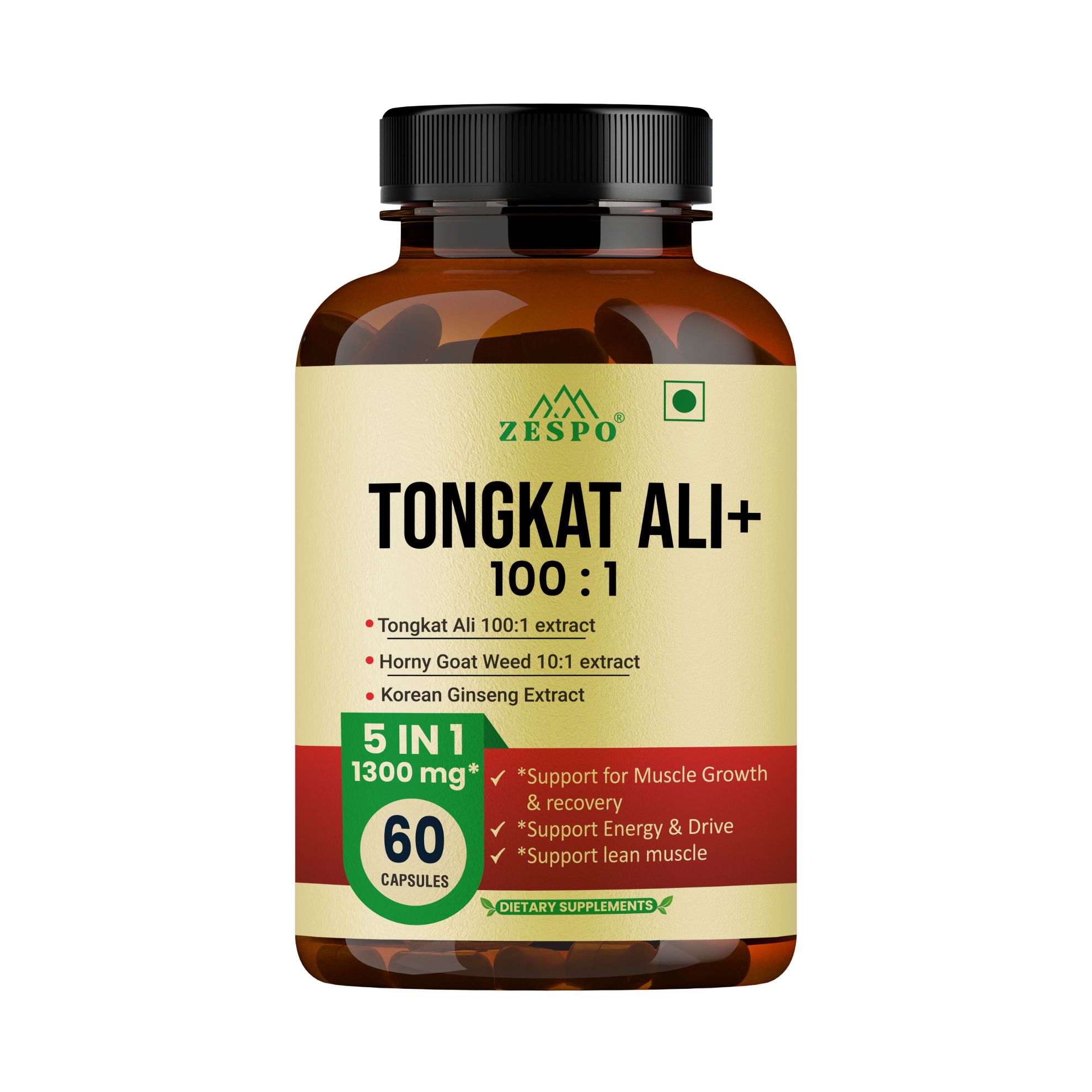
Label facts: Zespo Tongkat Ali Plus 5-in-1 Herbal Formula
- 1,300 mg per two-capsule serving
- Tongkat Ali 600 mg
- Horny Goat Weed 300 mg
- Korean Ginseng Extract 200 mg
- Beet Root 120 mg
- L-Arginine 80 mg
- 60 capsules per bottle – a 30-day supply at two capsules a day
- Suggested use on the label: two capsules daily with water, preferably with a meal
- GMP certified and lab tested
See the full label · Zespo brand facts · All Zespo links
Zespo products are nutraceuticals and dietary supplements, not medicines. This article describes ingredients and labels; it is not health advice. Consult your doctor if you are pregnant, nursing, taking medication or have a medical condition.
Leave a comment
Share your thoughts. We read every reply.